Archive for Uncategorized

Lebonese citizens stand up for animals

Don’t miss this article in the National Post on groups working to rescue animals from trafficking and abuse and inform the public about these sad yet preventable situations.

See:  http://news.nationalpost.com/2012/01/27/lebanon-activists-fighting-to-stop-animal-abuse-traficking/

Leave a comment »

It’s love that makes a family … even the furry kind

Recent events in my life have led me to think even more about family, a subject that I think about frequently anyway. But these past three weeks have been different, and will forever be different… as least for me.

I was moved by Zach Wahl’s speech in front of the Iowa State Legislature, because sometimes I forgot how much discrimination is perpetuated in our society.  This wonderful Youtube video by MoveOn.org is a great reminder of family regardless of age, sexual orientation and even… fur.

Leave a comment »

AMONG THE ANIMALS: Groups use different avenues to promote animal rights

By Christie Lagally

Originally printed in City Living

Copyright Pacific Publishing Company

I’m often perplexed why television and radio news do not have regular segments on animals. Sport enthusiasts enjoy coverage from Little League games to the World Series, yet articles on pets and animal welfare scarcely pepper our media landscape.

While a newscast like Monty Python’s “News for Parrots” re-broadcasts every story in terms of how many parrots were involved with this or that incident is only in jest, is it really so strange that we stay up-to-date on the latest news on animals and pets?

The League of Humane Voters (LOHV) of Washington is dedicated to providing knowledge of issues relevant and important to those who care about animals of all kinds.

Governmental change

Originally started in Washington by Mary Chmelik as a local chapter of the national League of Humane Voters, LOHV works diligently to inform citizens of animal-welfare issues before the Washington state Legislature and inform the public on the voting records of candidates running for office. This nonpartisan political action committee (PAC) endorses candidates based on pre-election surveys and past voting records.

In the last two years, Chmelik has seen the difference animal-welfare legislation can make. In 2009, the “Puppy Mill Bill” (Senate Bill 5661) was passed, restricting breeding-dog numbers and requiring full veterinary care and sufficient exercise for all dogs at breeding facilities.

This year, an amendment was passed to tighten the anti-cruelty laws to prevent ownership of certain types of pets after a cruelty conviction.

And, coming in the 2012 session, our Legislature will consider a bill (SB 5649) to prevent chaining dogs indefinitely in an effort to help prevent the tragedy of “backyard dogs.”

For citizens to choose their candidates and advise their representatives wisely, people must know what is being considered (or not considered) in the state Legislature. Hence, LOHV has formed a database of members who receive e-mail updates. Membership is simply a matter of visiting the LOHV website. There is no cost — just the knowledge that your next vote or call to your representative will be in support of issues important for the welfare of animals.

“People can save thousands of animals with just one vote,” Chmelik insists.

Public protests

But while our opportunities for government involvement are still relatively unique in the spectrum of world governance, it certainly is not the only way to change things for animals.

Across the country, the Occupy movement has made it clear that many citizens are unhappy with the actions of large corporations. The Occupy Wall Street quorum in New York produced a list of grievances that included “the torture, confinement and cruel treatment of countless nonhuman animals” committed by large corporations for the production of meat and consumer products.

To organize around this cause locally, the Occupy Seattle protesters have formed an Animal Rights & Environmentalism working group to address what changes should be made to prevent corporate abuse of animals.

Peter Keller, a member of Occupy Seattle, explained that many animal-rights groups have worked to change the behavior of consumers, such as encouraging people to avoid fur or to buy cruelty-free products. But the Occupy movement is different.

“Rather than ask for change among consumers, the Occupy movement is demanding change on the part of corporations,” Keller explained. “Right now, we are educating people on the issues, such as government subsidies that make animal products artificially cheap for the consumer.”

Additionally, the group is educating the public on the degradation of the environment from meat production.

As the working group grows, Occupiers hope to branch out and work for more direct change. To get involved with the Occupy Seattle Animal Rights &

Environmentalism working group, visit the Occupy Seattle website at occupyseattle.org.

A ‘silly’ approach

If helping improve life for animals feels daunting at times, don’t worry — you’re not alone. As it turns out, making a difference can be easy. Kim Sgro, the founder of Power to the Chickens (PTTC), has a way for all people to advocate for animal-welfare concerns from the comfort of their home, office or coffee shop.

“PTTC is an effort to bring the mainstream to animal-welfare causes through lightheartedness and simple reform action,” Sgro said. “One of the main ways we deliver our message is through being silly.”

Check out the chicken-chorus rendition of Snap’s “I’ve Got the Power” on the PTTC homepage ( http://www.powertothechickens.com) and the photos of supporters around the world doing the three-fingered “International PTTC Salute.” Photos have flooded in from near (the Fremont Troll) and far (the Norwegian
Arctic and Zimbabwe). Additionally, this website takes a different approach to alleviate serious animal-welfare problems, ranging from the dolphin hunting in Japan to dwindling bee populations in the United States.

PTTC points you directly to what you can do to make a difference, such as signing petitions or writing letters. It also includes “Good News” updates to show when animal-welfare reform has triumphed globally.

“Part of the intent of Power to the Chickens is to open the door in a nonthreatening way — to teach people from all walks of life how to get involved and open their minds to things they may not have considered before,” Sgro said.

Once the PTTC door is open, the world of creating positive change is available to all who enjoy life and want to make a difference.

CHRISTIE LAGALLY is a freelance pet columnist who manages the website “Sniffing Out Home: A Search for Animal Welfare Solutions” at http://www.sniffingouthome.org.h

Leave a comment »

Assembly and protest when the dog is in charge

The Occupy Wall Street movement has emerged with many surprises, but this one is my favorite.  Local Seattle blogger, Peter Keller, writes a fabulous blog on animal rights.  Check out this post: Top Dog at Occupy Denver

Leave a comment »

AMONG THE ANIMALS: Dog Yoga: The path to canine inner peace

Doga classes at the Seattle Humane Society

Published in City Living

(c) Pacific Publishing Company

November 9, 2011

By Christie Lagally

Health and wellness for your dog often consists of a few well-defined things. Good food, fresh water, plenty of exercise, proper veterinary care and something really good to chew on tend to be the basic requirements indicated by canine professionals.

But many dog owners know there is another vital component necessary for canine well-being: a strong, safe connection to a pack or family.

That human-canine connection and bonding is what Brenda Bryan was working toward when she developed dog yoga (or Doga) in collaboration with the Seattle Humane Society a few years ago.

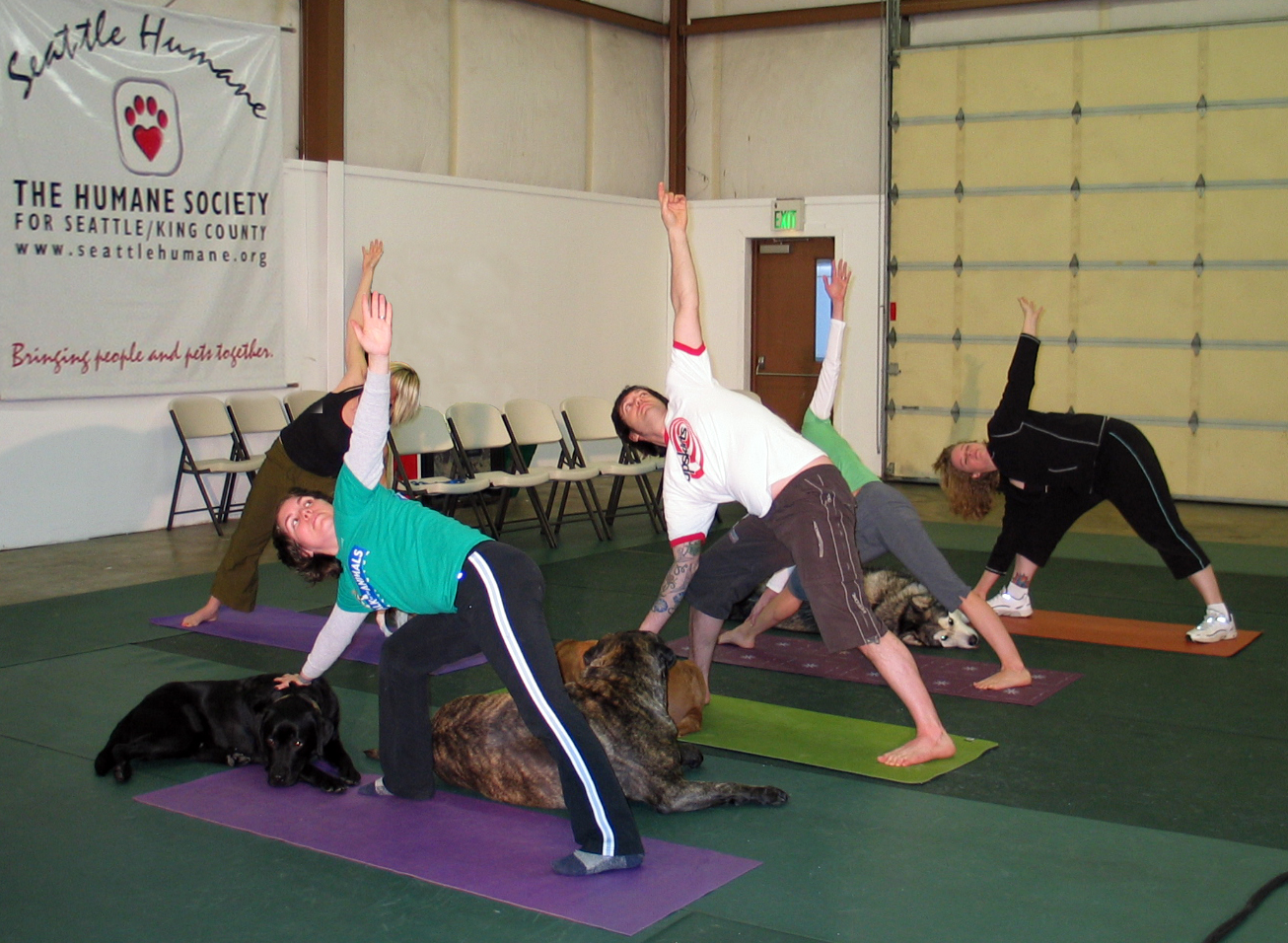
Brenda Bryan with her fellow Dogis

As a longtime yoga teacher and licensed massage therapist, Bryan describes this special style of yoga, which she calls “Barking Buddha,” as a “heart-opening practice for human and dog, allowing for time to develop a deep connection with each other.”

A calming effect

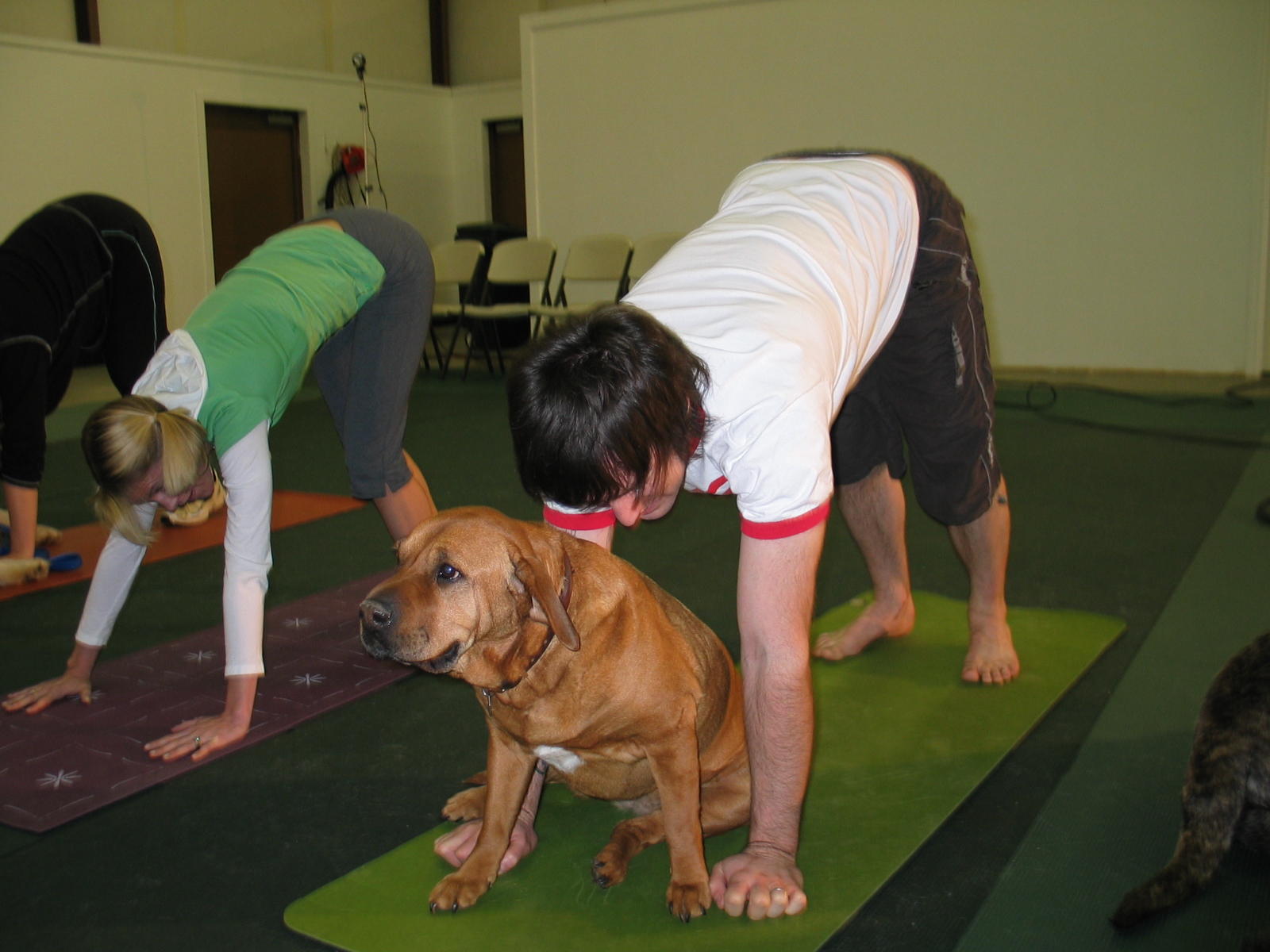
Doga is partner yoga with a very special, furry partner. Doga consists of poses such as Woofing Warrior, Pit-to-Paw Standing Twist and Canine Crunches, to name a few that engage both person and dog.

Dogs of all shapes and sizes are welcome, including those you might think would have difficultly staying on the mat for the length of class. Frequently, owners voice concern that their dog is not calm enough to attend a yoga class. Yet, Bryan said that the very practice of Doga often calms these sorts of dogs.

While Doga might be a bit unnerving at first, most dogs come to really enjoy the experience. Even dogs that are less-than-perfect with other dogs can benefit from the class. Bryan allows these “dogis” a little extra space away from other classmates so dog and owner feel comfortable and safe. In fact, many owners report their dog is eager to come to Doga class the next time around.


photo: Seattle Humane Society

Local classes

From Chicago to New York and Santa Barbara, Calif., dog yoga has popped up as a phenomenon in cities across the United States over the last few years. Most recently, a studio in the Sheung Wan district of Hong Kong began offering Doga, so it is not just in the United States where people are looking for a new way to connect with their canine friends. Many Doga practitioners remind us that dogs have been doing a kind of yoga, specifically Downward Dog pose, for eons and many of the Doga poses come naturally to dogs.

Even yoga-mat companies have become hip to the trend by offering yoga mats with dog (and cat) paw prints, but, of course, the mats are good for any yoga class.

As Seattleites, we are lucky to have Doga classes close by. Bryan teaches Doga at the Seattle Humane Society once a month ( seattlehumane.org). Spokesperson Joyce Zoldak said that the Seattle Humane Society began offering the Doga classes because they felt it would be a fun and relaxing activity that is good for owners as well as their dogs.

“The dogs love it just as much as the owners,” Zoldak said of the positive feedback she gets from the human Doga attendees.

Seattle Humane Society Doga classes are open to the public. Bryan said that dogs recently adopted may particularly benefit from Doga as they learn to bond with their new caretakers.

Doga classes are also offered at the Ginomai Community Center in West Seattle on alternating Saturdays. See the Barking Buddha blog at dogyogablog.com for more information.

In addition, a book or video about Doga can help you get started at home. Bryan’s book, “Barking Buddha: Simple Soul Stretches for Yogi and Dogi,” is available through Amazon or at the Seattle Public Library.

Because of the recent popularity of Doga, videos can be found on-line, as well.

CHRISTIE LAGALLY is a freelance pet columnist who manages the website “Sniffing Out Home: A Search for Animal Welfare Solutions” at http://www.sniffingouthome.org.

Comments (1) »

The ‘To Do’ list for this week

I miss my Richmond pit bull friends...

Well, work keeps us busy, the pets keep us busier (and well-loved) and the commute takes way too much time!  But… lets remember to do a few important things this week:

1)  Check out the Best Friends blog post, A Myth-Buster of a Day.

2)  Got puppy mills?  Well consider the fur industry which is a horrible puppy mill for wild animals.  Being ‘fur free’ isn’t even a lifestyle change, since faux-fur is easy to find.  Sign the petition on Care2 to encourage the fur ban movement.  It does work.  West Hollywood has banned the sale of fur in city limits.  Yeah!!!  People really do care about animal welfare.

3) Check out your local ‘Occupy’ movement and find what’s up! Here in Seattle the Occupy rally has a working group for Animal Rights and Environmentalism.

Why is this important?  Reform for animal welfare must go hand-in-hand with reform of our country.  Businesses are not playing fair until animal welfare is considered and adhered too.   Think it can’t happen?  It already is!  The US Humane Society and the United Egg Producers have agreed to work together to improve the welfare of laying hens!   And that leads us to number 4…

4)  Send a letter (don’t worry, it’s an easy online form) to your local lawmaker to encourage them to pass legislation for free-range egg production.


Leave a comment »

Bank Transfer Day rocked!

If we ever needed evidence that we are not alone in our fight to pay our bills and, furthermore, to struggle through the everyday maze that it is to move through our world of injustice, we certainly got that reassurance on Bank Transfer Day.

Yesterday thousands of people in the Seattle area (and across the US)  switched from large US banks to their  local credit union or bank.  (Seattle Times)

This is awesome.

This is the power we have to reshape our world!

This is where it starts – for the 99% of people and the 100% of animals too.  Everyday the tragedy of factory farming, pet homelessness and cruelty are among us.  At times our footsteps feel small, and traction is fleeting.

But Bank Transfer Day wasn’t just about money — as you already know.  It was about the power to change our destiny by walking away from injustice and participating in the alternatives.

If the 99% walked away from pet stores selling animals, there would be no more puppy and kitten mills.  If the 99% walked away from commercial meat sales, there would be no more factory farming.  If the 99%, banned exotic animal sales, there would be no more wild animal trade.

But it is no longer an “if” we walked away, because we “are” walking away.

You have the choice, and Bank Transfer Day showed how much that choice matters.

Leave a comment »

Buca’s on the ballot, so remember to vote!

Buca helping with mail-in voting.

Seattle and King County ballots are due by Nov. 8th.  For more information, see the King County Elections website.

Leave a comment »

Best Friends: Progress, love and resolution for pit bulls

Comments (2) »

Why Occupy Wall Street includes the fight for animal welfare

When the Occupy Wall Street protests began to thrive in the US and around the world, frequent commentary on lack of focus or specific demands seem to litter the media.  But the more I watched and waited,  I began to realize this movement has never been out of focus, it’s just too big for our current lens.

Some realization came while watching a compelling commentary by a literature graduate student in NY regarding his efforts to establish a library at the Occupy Wall Street demonstrations (see YouTube).  He knew that his efforts to simply provide knowledge was a protest in itself.

This is equally true with the issue of animal welfare.  Once people are aware of animal cruelty and torture — particularly in the case of farm animals —  no matter how gruesome the reality may be, the knowledge of the issue allows us the option to forgo participation in a cruel system, and often easily disarm the problem by economic participation in the alternatives.

But this isn’t breaking news….

As was so eloquently reported by One Green Planet and effectively detailed in this article by the Animal Legal Defense Fund,  the ‘Occupy’ movement has included the welfare of animals as a justifiable demand on the reform of, not just corporate America, but America in general.

From vegan-ism to banning pet stores sales, our struggle to stop the cruel and horrific treatment of farm, wild and companion animals has often glided  along side other issues of  inflation, pesticide use, heart disease and environmental degradation — or so we may have thought.

But, as it turns out, we are not alone — whether meat eater, farmer, feral cat rescuer, hunter or conservation biologist, none of us wants the cruel treatment of animals, just like none of us wants to be controlled by corporations exhibiting  greed, inequality and illegal or abusive action.

So I find it very natural that Occupy protests include the demand for corporations to end the cruel, industrialized and institutionalized  treatment of animals.  This demand is no longer too big to be considered for mass reform. In fact at this point, improving welfare for animals in all situations, is practically a simple first step.

Leave a comment »