Archive for Uncategorized

Maddie’s Fund supports no-kill movement with hard data

Following is a news release from Maddie’s Fund:

NEWS RELEASE:    MADDIE’S FUND® RELEASES FIRST COMPARATIVE DATABASE OF SHELTER STATISTICS

Intake, adoption, and euthanasia numbers from 474 animal shelters and 56 communities reveal status, trends and progress of US animal sheltering

(Alameda, CA-July, 2011). For the first time in animal sheltering history, reliable data from a large sampling of shelters and communities across the United States has been compiled into a single, searchable database. The Maddie’s Fund Database provides two years of intake, adoption and euthanasia statistics from 474 shelters and 56 communities using Asilomar Accords reporting methods and formulas.  The database allows lifesaving to be measured within a community and to be compared to others. Search categories include geographic region, median income, size of human population, total intake, total adoptions, total euthanasia, live release rate, and deaths per 1000.

Data of this kind has never before been available, leaving elected officials, shelter managers, universities, statisticians, investigative reporters, contributors and animal loving citizens in the dark about how well their community is doing in its lifesaving work and how it stacks up against other communities of comparable populations (human and animal).

“I can’t overstate the importance of this information,” says Maddie’s Fund President, Rich Avanzino. “Without hard numbers, it’s impossible to know where we’ve been, where we are at and where we are going. Maddie’s® Database not only gives us a handle on this, but also inspires communities that are below the norm to catch up with the lifesaving gains being made in progressive communities, and gives them the information they need to convince their elected officials, donors and community members to get on board and help them move forward.”

Information for the database was submitted by Maddie’s community collaborative project participants, special giving grantees and Maddie’s® Community Shelter Data Grant recipients who were given $10,000 to $40,000 to provide statistics for two previous years and three years going forward. All data has been carefully reviewed by Maddie’s Fund staff.

About Maddie’s Fund

Maddie’s Fund®, The Pet Rescue Foundation, (www.maddiesfund.org) is a family foundation which is funded by the founder of Workday and PeopleSoft, Dave Duffield and his wife, Cheryl. Maddie’s Fund is helping to create a no-kill nation where all healthy and treatable shelter dogs and cats are guaranteed a loving home.  Maddie’s Fund is named after the family’s beloved Miniature Schnauzer who passed away in 1997.
Leave a comment »

City Living – AMONG THE ANIMALS: Two Projects on lookout for free-roaming, feral cats

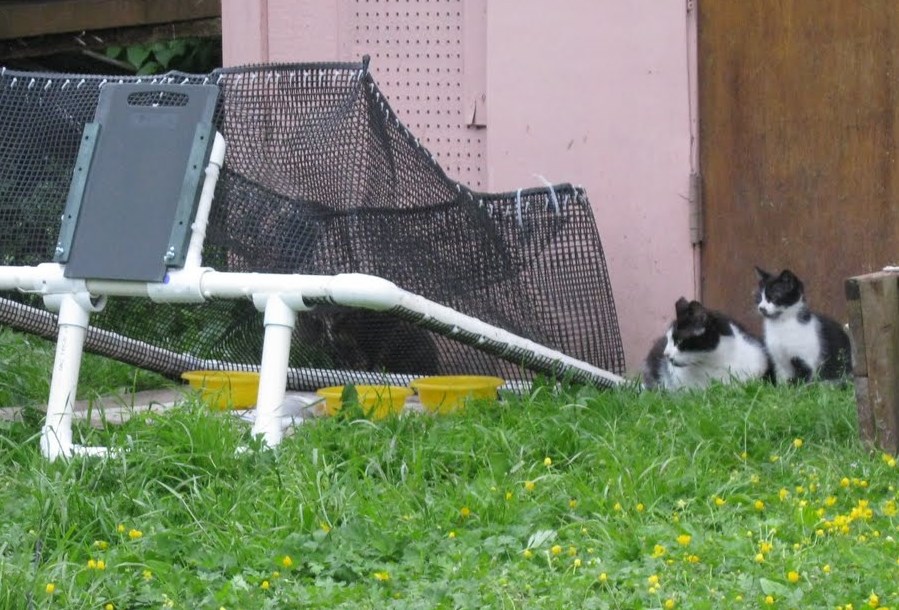
Mom and kitten observing a humane trap (Alley Cat Project photo)

Originally printed in City Living
Pacific Publishing Company
By Christie Lagally

What we need is a neighborhood watch…for cats.

It wouldn’t be a typical neighborhood watch, of course, but the benefits would be similarly favorable. What if you kept your eye out for stray or feral cats in your neck of the woods and made a quick call if you saw one?

That is the hope of Kate Rich, cofounder of the Alley Cat Project in Seattle. Rich and her colleagues have a mission: to trap, spay or neuter, and return every feral or free-roaming cat in Seattle. In 2011 alone, they’ve already assisted more than 180 cats, and they are called upon by the public almost daily to deal with colonies of cats and pregnant or nursing mothers.

“These are the calls we like to get,” Rich said, referring to calls from keen residents who notice a mother cat. “If we can take care of the mother and babies now, it doesn’t turn into a bigger problem, like a colony of cats.”

Removing barriers

Clearly a pragmatist when it comes to animal-welfare issues, Rich and five other volunteers started the Alley Cat Project in 2008. While there are many not-for-profit groups providing trap-neuter/spay-return (TNR), Alley Cat Project focuses on just the city of Seattle so as not to burden their volunteers with long-distance driving out of the city. Rich said it’s more efficient to work within an area where you live, and other groups do the same.

TNR is a free-roaming-cat management technique that involves trapping feral and stray, but tame, cats and sometimes entire colonies of cats; spaying or neutering them; and ultimately returning the cats to their site of origin.

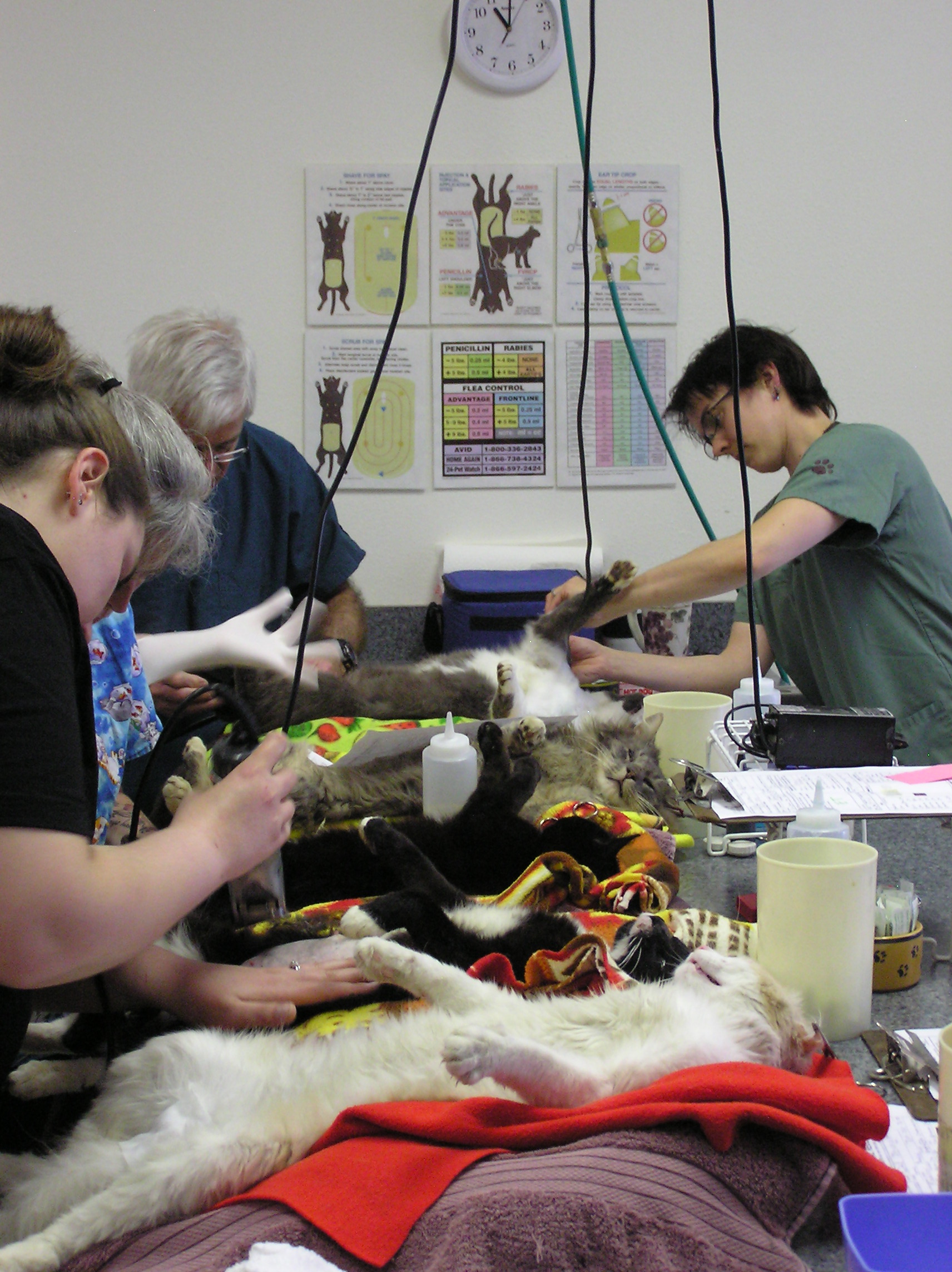
Prep table at the Feral Cat Spay/Neuter Project.

While the Alley Cat Project takes care of the trap-and-return part, Rich and her colleagues turn to the Feral Cat Spay Neuter Project (FCSNP) in Lynnwood to spay or neuter the cats. FSCNP are focused on providing low-cost and no-cost spay/neuter services to humane trappers, nonprofits and the general public. “It’s all about removing the barriers to spay/neuter,” said FCSNP executive director Lauren Glickman. “We are a tiny organization with huge results.”

That’s an understatement, I thought as I toured the animal clinic on a beautiful Sunday morning in June. I was nearly overwhelmed by the speed, care and diligence with which every cat was fixed. In fact, this tight operation has fixed more than 66,000 cats since its inception in 1997 and continues at a rate of 200-plus cats per week.

Starting at home
While FCSNP was originally founded to spay/neuter the multitude of feral and freeroaming cats in the Greater Puget Sound area, currently, around 60 percent of the animals brought to the facility are owned cats. The requested donation from the public is just $25 for females and $15 for males.

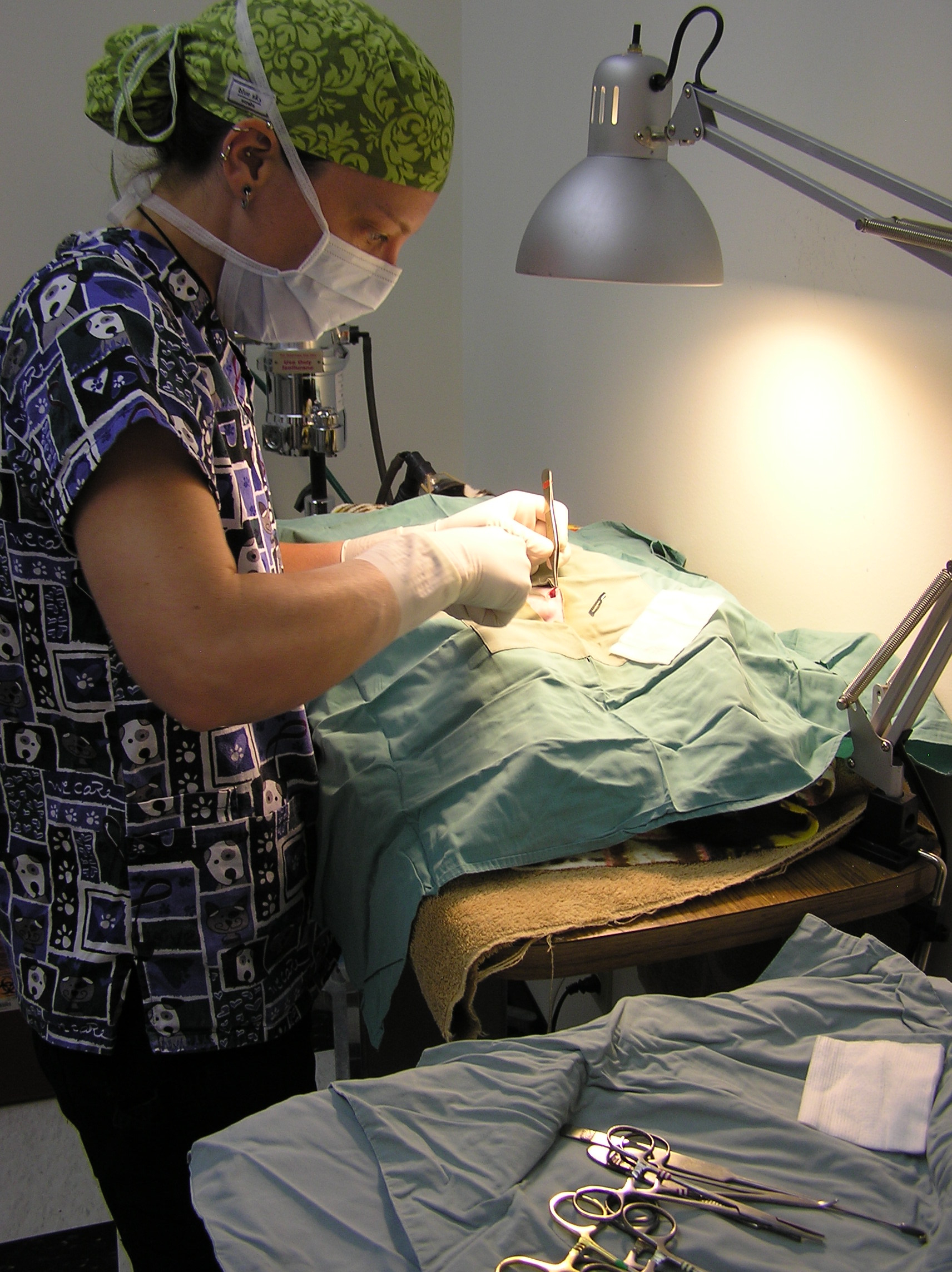
Veterinarian at the FCSNP

This price point makes sterilization possible for any cat owner, and the shift to serve the public more frequently is a testimony to FCSNP’s success: The more the organization can reach out to cat owners to spay/neuter, the fewer feral cats are born onto the streets. As for the neighborhood watch, Rich said that cat colonies usually aggregate around a single food source: either waste food in a dumpster or compassionate individuals saving cats from starvation. But without population control, feeding freeroaming cats turns into feeding a colony of cats in a very short time. These cats have become feral because someone didn’t heed the call to fix their cat.

To learn more about the Alley Cat Project and the Feral Cat Spay/Neuter Project, visit their websites at www.alleycatproject.org and www.feralcatproject.org. Donations can be made to either group through their websites. FCSNP maintains an Amazon wish list, an easy way to purchase specific items required for the spay/neuter clinics. The Alley Cat Project can use donations of clean towels and canned cat food. Most of all, they advise that owners make sure their cat is spayed or neutered.

CHRISTIE LAGALLY is a freelance pet columnist who manages the website Sniffing Out Home: A Search for Animal Welfare Solutions at http://www.sniffingouthome.org.

(C) Pacific Publishing Company

Comments (1) »

Vancouver Sun highlights puppy issues

I’ve always enjoyed the “Puppy Love” column by Kim Pemberton in the Vancouver Sun.  Here is a great article — part of a series — about the better option to ‘adopt don’t shop’. See here.

Comments (1) »

‘Sniffing Out Home’ now has a permanant home!

This is an exciting post for me, because it’s the announcement of the new ‘Sniffing Out Home‘ website!  Up until now, I managed my blog, called “Sniffing Out Home:  A Search for Animal Welfare Solutions”, as well as the resource page for the Animal Welfare Advocacy Coalition (AWAC) from  site at ‘christielagally.wordpress.com’.  This location was worked well for our advocacy efforts and to help people access information about where to go and how to help animals in their community and country.  But, alas, it’s time to settle down to a reliable, permanent site!

The new website is appropriately located at www.sniffingouthome.org.  You may have already been auto-forwarded to this site.  If so, welcome!

Comments (1) »

Suffolk County (NY) has the makings of a better law for puppies

This quote made my day!  It’s from the North Shore News in Suffolk County NY.

“It’s time Suffolk County joins a national trend and bans these businesses that support the puppy mill industry.”

I’m sure glad to hear this called a ‘national trend’.   Suffolk County legislator Jon Cooper has proposed a law to ban the retail sale of dog in pet stores.  See article here.  The proposed law will take some time for consideration, and the public is asked to participate.   Here is a web comment from that same article inviting input.   Three cheers for Suffolk Co. and Jon Cooper!

Comment from Jon Cooper (reprinted):

Thank you for posting this story about yesterday’s public hearing on my “puppy mill” bill. If any of your readers would like to testify in support of this bill at the next public hearing, they can call my district office for full details at (631) 854-4500. They can also email me at jon.cooper@suffolkcountyny.gov. The hearing will take place at the next General Meeting of the County Legislature in Hauppauge and is scheduled for 6:30 PM on Tuesday, August 2nd.

Leave a comment »

A legal review of Richmond’s puppy sale ban court decision

While reading the outcome of the BC Supreme Court’s decision on Richmond’s puppy sale ban (International Bio Research v. Richmond (City)), one might be tempted to skip a bit of the technical details.  Here is a review of that ruling from the Association of Corporate Counsel that gives some insight into the more community law issues of the matter.

Leave a comment »

Am I on the fringe of society (I mean IRS tax code) for helping animals?

Feral cat from Richmond, BC farm

This week the  IRS was required to change its tune when it comes to some less than popular tax deductions.  A women in California claimed the expenses she incurred from assisting a 501(c) 3 animal rescue group to save feral cats from living on the streets in Oakland CA.  She defended her claims in court, and while her win — requiring the IRS to allow her deductions — really isn’t specific to those assisting animal rescue groups, it appears that the media saw it as such.

The Wall Street Journal, who essentially broke the story, reported the case as a legitimate redefinition of what could be considered as a tax deduction when a volunteer spends his or her own money on genuine expenses for a no:n-political, registered charity.  However, the fever of media stories that followed focused on the ‘crazy cat lady’ angle of the story.  See one example here: IRS can no longer discriminate against extreme cat lovers.

There is no doubt in my mind that Jan Van Dusen, the plaintiff in the case, loves cats.  But I don’t think this success should be touted as a singular victory for animal rescue volunteers as much as it is for all volunteers who spend their money for many different charities to fight domestic violence, prevent environmental pollution or assist in AIDS prevention.

Don’t get me wrong.  This is wonderful news, and it’s wonderful that this case was fought over tax deductions for a cat rescue group.  But would there be the scurry of news articles about this issue if the case hadn’t involved animal rescue?  There would be some, but I think mainstream society would view deductions taken by volunteers to help the (human) homeless to be much more palatable.  Would the IRS have questioned someone who claimed expenses for spending their own money to clean up a school yard or to prevent pollution  (under the direction of a 501(c)3 of course)?

My guess (and it’s just a guess right now) is probably not.  The IRS accused Van Dusen of trying to deduct personal expenses, even when those expenses resulted from fostering roughly 70 cats in her home through Fix Our Ferals — probably while they waited to be released or adopted.  Everything from paper towels to electricity are heavily used when you foster cats, and those are the deductions that Van Dusen claimed. Perhaps the IRS didn’t know what it takes to foster cats?

Animal rescue is no different a philanthropic endeavor than helping homeless people, feeding the hungry or saving the environment.  Yet for some reason it’s seen as the volunteer activity that is conducted by people on the fringes of society, and that spending money on the rescue of cats is a luxury, not a necessity brought on by a social problem.

Yes, there are fanatics who try to rescue every cat and bring them into their homes, but there are fanatics in every group of people.   What Van Dusen, and those volunteers like her are doing is filling a gap in society that is otherwise unmet.  We have a feral cat and animal overpopulation problem in the US and Canada.  Rescue workers are trying to alleviate this problem, and would love nothing more than to celebrate the day when every cat has a safe and loving home.    But these volunteers are not ‘crazy cat ladies’ for taking in 70 foster cats or spending their own money to fix (no pun intended) a feline overpopulation problem.

As an animal rescue volunteer, I’m not on the fringes of society — I am the society, and so are my fellow animal advocates who work to bring balance to an issue that is so out of balance.

A special thanks to Deborah Howard of the Companion Animal Protection Society for posting this story on Facebook. 

Comments (1) »

Retail pet sale bans are spreading … to Los Angeles!

While the rise of puppy mills and retail pet sales in the decades after WWII was a set back for animal welfare progress, the tide has shifted in the last few years.  In general, puppy mills and pet stores selling animals have been unwilling to act ethically and humanely and to stop the ripple of problems and cruelty they cause by indiscriminately breeding and selling dogs, cats, rabbits and other pet store animals.

It’s very sad that cities, like Richmond, BC in Canada or West Hollywood in the US, must actually ban such blatantly cruel practices in order to stop the activities of Hunte Corporation and other such puppy mills and puppy distributors.  Meanwhile, you would think that people who work with dogs in these pet stores  would see the harm they are causing, and make changes to stop retail sales.  But change is not coming from within the pet stores or the animals mills.

And so it goes, on Tuesday, June 7th, the Los Angeles City Council voted to draft a bylaw to ban the sale of dogs, cats, rabbits and chickens.   Los Angeles’ department of animal services has been directed to draft the law, which would affect around 100 pet stores selling animals according to dvm350.com.  Councilman Paul Koretz proposed initiative, and the decision to draft the bylaw was unanimously voted in by his fellow council members.   Yippee!   I can’t wait to see the bylaw!!!  See one article here.

Back in October 2010, a reporter for CTV asked me (after the vote  for Richmond to ban the sale of dogs in pet stores), “Who are the winners from tonight’s vote?”   After a 3-hour of city council meeting, I simply answered that the dogs who were saved were the real winners.  But as I’ve thought about that question these last few months, I’ve come up with some very different answers.  The real winners from banning the sale of animals in retail outlets are the pet store owners and puppy mills themselves.  Because while most of us want to do ‘what’s right’, apparently for some people it’s easier to be blinded by greed  while staring directly at animal cruelty.    The real winners were the pet store owners and the puppy mills who, when being unwilling to make the ethical choice to stop their practices, are having that choice made for them — just like in Los Angeles, Richmond, BC, South Lake Tahoe, Albuquerque, Hermosa Beach, CA, Lake Worth, FL, and the list will get longer… thankfully.

Today we celebrate those people who are fighting the good fight to progress the state of animal welfare.  Thank you!

Leave a comment »

City Living: Among the Animals – Sunday’s Furry 5K helps care for shelter animals

photo provided by the Seattle Animal Shelter

Printed in City Living, Seattle
June 8, 2011
Copyright Pacific Publishing Company

AMONG THE ANIMALS
By Christie Lagally

My husband and I had no idea what we had gotten ourselves into.

It wasn’t just that we’d never had a puppy before we adopted our dog, Toby, in 2008. The surprise came when we got DNA results that said our plain-looking, black-and-white shelter puppy was actually a Saluki (Persian greyhound) cross. Little did we know that Toby would make our lives all about running and figuring out how, where and when he could sprint his little heart out.

Toby is 3 years old now, and because of his unending desire to run long distances, we finally moved into a house with a big yard. For the first time, Toby is content — as every dog should be.

But helping pets get the exercise they need isn’t quite as easy for dogs awaiting homes at the Seattle Animal Shelter. Luckily, Seattle’s shelter canines have an army of volunteers to appease their exercise appétit.

The Get Fit with Fido volunteer running group at the Seattle Animal Shelter runs the rambunctious dogs three days a week. The experienced dog handlers wear sporty Get Fit with Fido jackets and typically run the dogs from Interbay, through the Olympic Sculpture Park and into Downtown Seattle. This partnership enables these experienced runners to get in some good athletic training, and of course, the dogs get exercise and socialization.

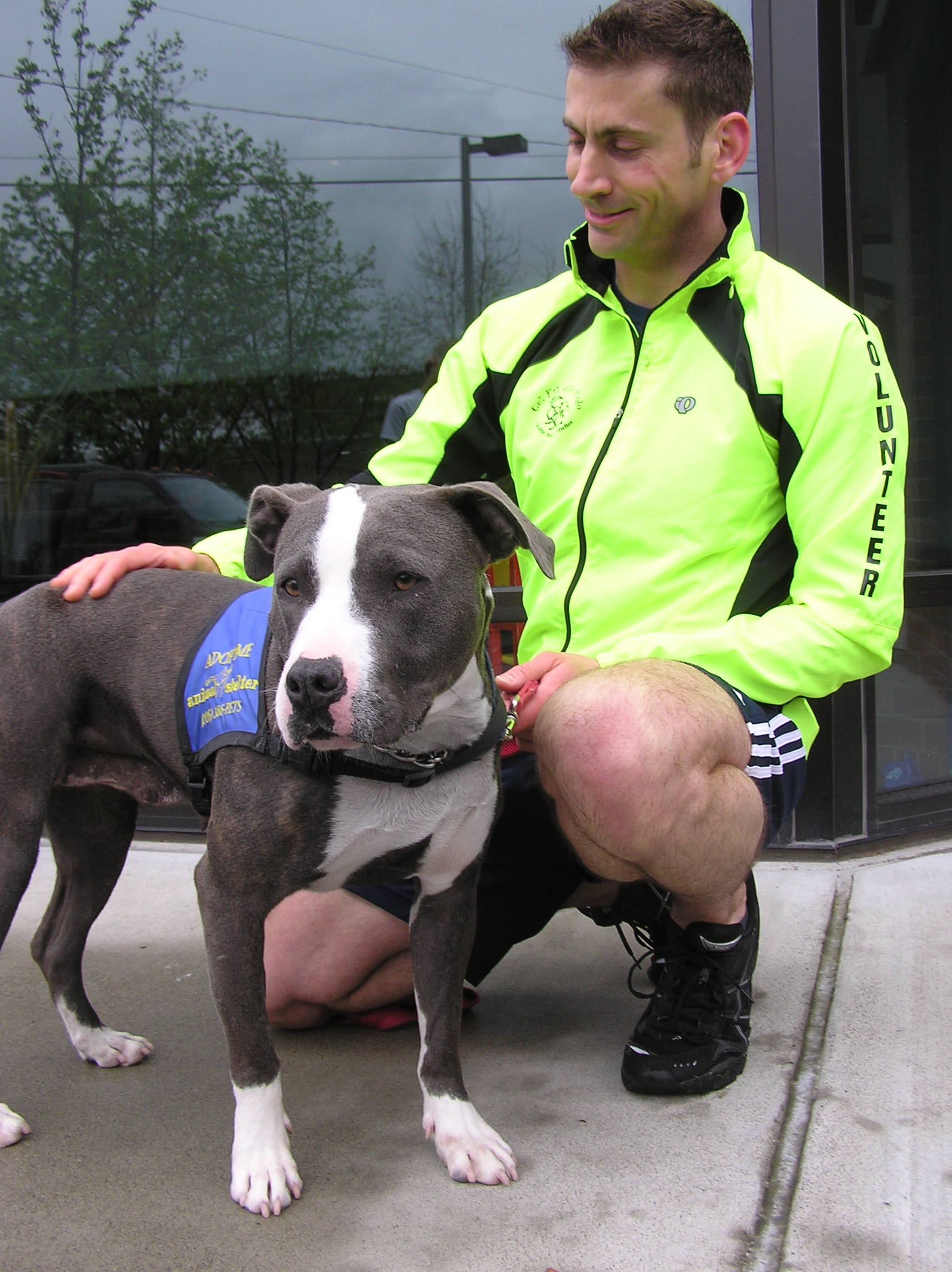
Velvet and Paul at the Seattle Animal Shelter

Velvet and Paul at the Seattle Animal Shelter

Fund-raising, education

About 12 years ago, the Get Fit with Fido volunteers decided to do more for the shelter animals and organized the Furry 5K, an annual fund-raising, run-and-walk event coming up this Sunday, June 12.

I caught up with Get Fit with Fido volunteer Paul Paladino upon his return from a weekly run with Velvet, a 3-year-old, blue-nosed pit bull available for adoption at the Seattle Animal Shelter. Velvet and Paul were happily grinning at each other in that tired, after-a-good-run kind of way. Paul was telling me how, at the upcoming Furry 5K, he’ll volunteer to help make the event a success.

The Furry 5K is at Seward Park and begins at 10 a. m. Runners, walkers and well-behaved dogs on leash are encouraged to come out and raise money for the Help the Animals Fund. While the city pays for the cost of basic operation of our animal shelter, the money to pay for veterinary and dental care for the shelter animals comes entirely from fund-raising and donations to the Help the Animals Fund.

You can pre-register for the Furry 5K on-line at www.furry5k.com for $25 per person. Raceday registration is $30 and takes place between 8:15 and 9:45 a. m. Runners and walkers receive a race shirt, but only while supplies last. Also, dog participants receive Furry 5K bandanas for their hard work.

Prizes will be handed out for the fastest runners and fastest dogs with a runner. (Note that winning dogs must be attached to a runner by leash at all times).

But Sunday’s fun doesn’t stop at the end of the 5K course. You and your dog can head next to the Animal Product Expo after the race.

In addition to product displays from local pet-related businesses and Animal Shelter supporters, the expo also features entertainment. Visitors will get to watch an agility dog team and the Ahimsa doggie drill team. This definitely constitutes entertainment geared toward both you and your dog.

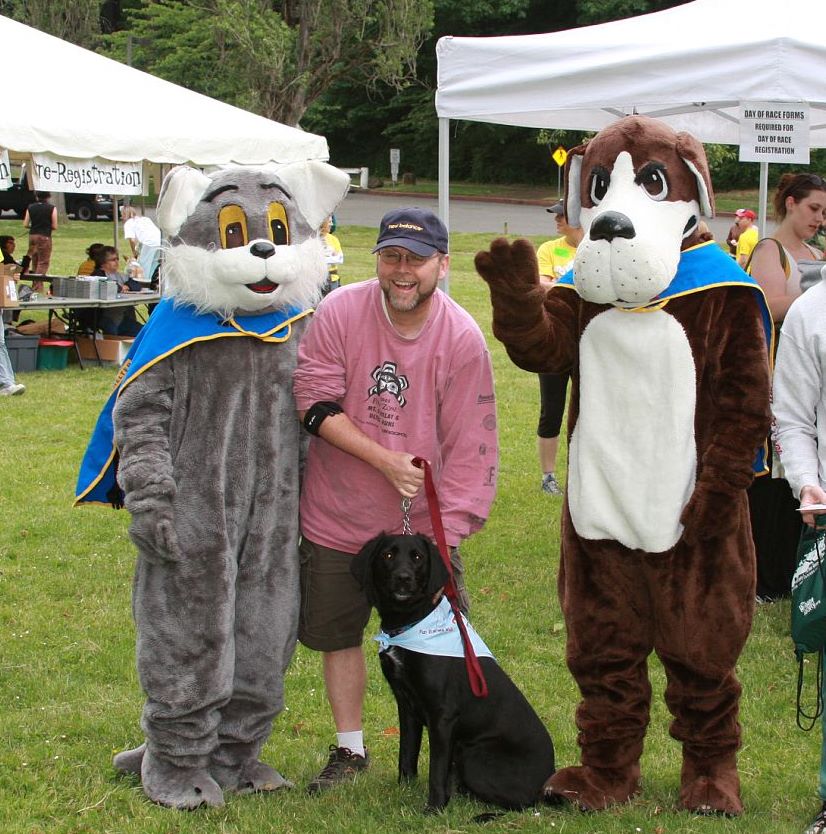
Fluffy and Fido - shelter mascots

The Seattle Animal Shelter mascots, Fluffy and Fido, will greet visitors. The expo is open to race runners, walkers, well-behaved dogs and the general public, as well.

I can hardly wait for Sunday, and I’m geared up for running the race. Toby, on the other hand, has been ready for the Furry 5K his whole life.

And while he would no doubt either win, place or show in a dog-only race, it’s unlikely that the Toby-plus-Christie team will be in the first 1,000 to cross the finish line.

Christie Lagally is a freelance pet columnist who writes a blog on animal-welfare issues at christielagally. wordpress.com.

Copyright Pacific Publishing Company

Leave a comment »

Canadian friends! Can you vote for RAPS in the Pepsi Refresh Grant Program?

It’s easy, and it helps animals in Richmond, BC!  The Richmond Animal Protection Society (RAPS) is just a paw away from being in the money to receive a grant from Pepsi and provide spay/neuter services to low-income residents of Richmond.    Vote here once a day to help them make it into the top two places to receive a grant.  Let’s not miss this opportunity to make a dent in animal homelessness in Canada.


Leave a comment »