Good news from the US Senate on a dog fighting amendment for the Farm Bill. The HSUS has announced that it will included as part of another amendment. See Wayne Pacelle’s blog for more information.
Archive for Uncategorized
If you’re against cruelty, why aren’t your senators?
Are you against dog and cock fitting? Are you against hens in battery cages and inhumane factory farms?
Whether you are a Republican or a Democrat, you are not going to be happy with this news. (The Republic, Seattle PI, SF Chronicle)
Last night the US Senate denied consideration and debate of two amendments to the farm bill that would 1) improve the lives of chickens on factory farms and 2) cracks down on dog fighting and cock-fighting (remember Micheal Vick’s major case).
Both amendments had considerable support in the US Senate and the egg industry reform amendment was sponsored by Democrats, Republicans and Independents including Sens. Richard Blumenthal, D-Conn., Scott Brown, R-Mass., Maria Cantwell, D-Wash., Susan Collins, R-Maine, Joseph Lieberman, I-Conn., Bernard Sanders, I-Vt., David Vitter, R-La. and Ron Wyden, D-Ore and several more. (HSUS)
Note that it was not the egg industry that was against this amendment! In fact, the United Egg Producers Association was a huge supporter of the amendment and advocated for its passage.
So what went wrong last night? A group of lobbyists (American Farm Bureau Federation, the National Cattlemen’s Beef Association and the National Pork Producers Council) are too afraid of their own customers. Their fear — that they will have to be humane to animals. (HSUS)
“This is a matter of self-determination for the egg industry,” said David Lathem, second-generation egg farmer from Georgia and chairman of UEP in a press release several weeks ago. “No other sector of animal agriculture should prevent our industry from innovating, improving animal welfare, and finding best practices that will protect our farmers and answer major questions posed by consumers.”
So if congress will not or can not act on our behalf, we do it ourselves.
First it’s our duty to stop buying any meat from producers who are continuing to treat animals inhumanely. Meat can be obtained from local humane farms or easily from Whole Foods (see post here).
Second, support the Humane Society of the US who will work to include these amendments in the US House version of this bill (See Pacelle blog).
Lastly, write to your local newspaper in response to this news story (Seattle PI). Let them know how factory farms, dog fighting and cock-fighting causes us personal pain as we feel deeply that animals, regardless of their role in agriculture, should be treated humanely.
Also, you can let you representatives know that you want to see action on humane issues for farm animals.
“The Bond” book signing in Northgate Seattle
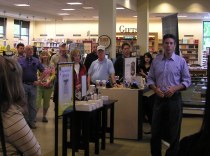
Wayne Pacelle (HSUS) at the Northgate Barnes & Noble
With more dogs than children, it was a typical Seattle event at the Barnes & Noble yesterday morning when Wayne Pacelle, President of the HSUS came to talk about our human responsibility towards animals — a topic included in his book The Bond: Our Kinship With Animals, Our Call to Defend Them.
The group discussion was started with a great bit of local support for St. Matthew School in the Lake City area. Nancy Edwards, school librarian, passed out coupons to visitors that allowed part of B&N’s proceeds from a purchase of “The Bond” to go towards the school’s book fair.
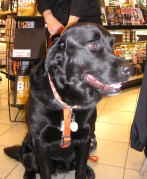
River that greeter dog
Our friends from PAWS were also in attendance, and River, a big black sweetie, greeted people at the door. As an organization, PAWS works to help our community integrate with local wildlife and serves companion animals.
Pacelle’s talk on the issues of animal welfare, and especially advocacy to prevent cruelty, included animals from horses, chickens to laboratory animals. The crowd was well prepared with questions, and listened with engagement.
Ruth Kildall asked a question of particular interest to Washingtonians about why the HSUS decided to forgo the state ballot initiative (I-1130) to ban chicken confinement pens and instead pursue national legislation for the improvement of conditions for all hens. Clearly other audience members had the same questions, as ears perked up once again.

Local Seattle activists Claudine Erlandson and Ruth Kildall at “The Bond” book signing.
Pacelle’s reasoning was one of resources, and he explained that the HSUS and local constituents could help the majority of hens in the US by pursuing national legislation rather than state initiative. A state initiative would have required considerable resources beyond the successful signature gathering. Furthermore, such initiatives would only be an option for advocates in states where the ballot initiative method is allowed to circumvent the state legislature. The grim outcome of a patchwork of state laws to protect chickens could mean that the majority of US chickens would reside in states with no protection laws, Pacelle explained.

Wayne Pacelle explaining Meatless Mondays
Pacelle also encouraged us to choose Meatless Mondays to reduce the amount of meat we eat as a society. “Meatless Monday saves the lives of 1.5 billion animals a year.” explained Pacelle.
In the company of friends, this book signing was a reminder that our goals to prevent cruelty to animals are shared by so many people right here in my own backyard of North Seattle.

An AHELP hospice dog, waiting for the book signing, sticks his tongue out at me.
AMONG THE ANIMALS: Valuing our bond with animals

Wayne Pacelle (courtesy of Paul Markow Photography)
By Christie Lagally
Originally published in City Living Seattle
(c) Pacific Publishing Company
June 13, 2012
It is amazing to realize, but there are few parts of our lives that do not influence the lives of animals.
We share our neighborhoods with squirrels and raccoons, our nature parks with wildlife and our oceans with sea life.
We purchase every kind of animal product from dairy and meat to leather and gelatin that come from animals whose welfare is often inadvertently ignored.
Commercial products, like laundry soap or cosmetics that are tested on animals can be difficult for the consumer to identify and avoid.
But these conditions do not necessarily indicate a lack of good intention. If fact, I have met devoted carnivores who care deeply for cows, chickens and pigs and fight against factory farming, as well as vegans who are not particularly attached to animals. So like many people, I am perplexed by the contradictions in our society’s relationship to animals.
I recently gained insight into this matter during a conversation with Wayne Pacelle, president of The Humane Society of the United States (HSUS). Pacelle is author of the New York Times best seller “The Bond: Our Kinship with Animals, Our Call to Defend Them,” and he will speak in Seattle on Saturday, June 16, at 11 a.m. at the Northgate Barnes & Noble store.
An economy in sync
Pacelle is an experienced advocate for humane treatment of animals. His career with the HSUS — first as a spokesperson and then president of the HSUS — spans nearly 18 years.
In his last eight years as president, the HSUS has grown to be one of the world’s most comprehensive animal-welfare and advocacy groups, now counting 11 million members in its ranks. While the organization supports rescue efforts, it also focuses on fostering significant legislation to help prevent cruelty and to improve the lives of companion, farm, laboratory and sport animals alike.
Pacelle’s book is an exploration of what he describes as the “the bond” — the natural awareness, appreciation, respect or love we have toward animals whether they be our pets, our native wildlife or the cows and pigs we may see at a distance.
“There are so many different expressions of ‘the bond.’ It is part of every one of us to have empathy for animals,” Pacelle explained.
Yet, in spite of that inherent bond, we allow or participate in horrific acts of cruelty — from puppy mills and factory farms to baby-seal clubbing in the Arctic for the fur trade. According to Pacelle, this disconnect between what we naturally feel about animals and the way we treat them has both historical and cultural roots. We may grow up unaware of where our food comes from, and economic or societal pressures may lead us to ignore the welfare implications of our purchases.
In “The Bond,” Pacelle argues that it is possible to bring our economy in sync with our values by making humane choices for food products or buying products that don’t harm animals. Purchasing cage-free or free-range eggs and buying meat from farms where animals are treated humanely are conscious choices we can all make.
Similarly, seal watching, like whale watching, would be an economically conscious way to convert the fur trade to one of ecotourism, according to Pacelle.
In line with values
Many Seattleites heard his advice loud and clear. In our community, we put considerable focus on our local humane farms, raising backyard chickens, adopting our pets or even choosing veganism. But it is it often difficult to make animal welfare a priority in every part of one’s life.
In that regard, I am grateful for the multitude of animal-welfare groups in the Seattle area. The Progressive Animal Welfare Society (PAWS), with locations in Seattle and Lynnwood, is one such organization that guides our community in making humane choices. PAWS is co-hosting Pacelle’s talk on Saturday and will provide information about its programs for animal adoption and cohabitation with wildlife.
“We really support the work that Wayne Pacelle and HSUS are doing,” said Mark Coleman, communications manager at PAWS. “PAWS encourages people to consider every option for living humanely.”
While this advice is often easier said than done, the HSUS has had unprecedented success on the national level working to improve the lives of farm animals. In May, the U.S. Senate introduced the Egg Products Inspection Act Amendments of 2012, which was jointly supported by the HSUS and the Egg Producers Association — seemingly unlikely partners in the past. This legislation would double the amount of space for laying hens.
Similarly, fast-food companies like Burger King and McDonald’s have announced their future commitment to improving the treatment of pigs by phasing out cramped gestation crates used for pregnant sows.
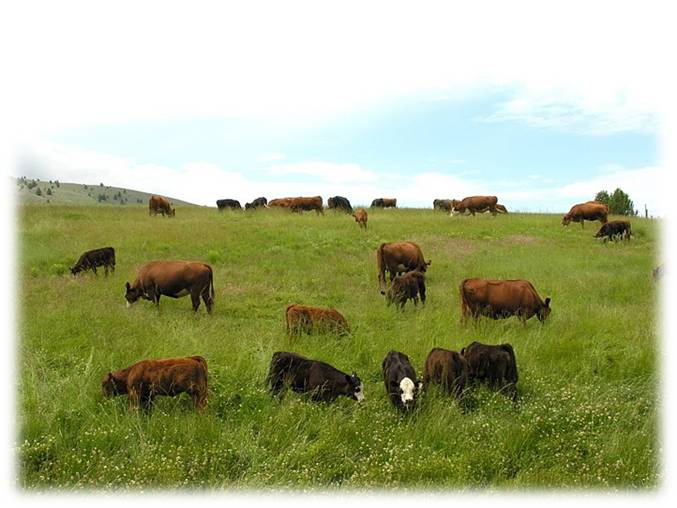
Cattle grazing at Country Natural Beef, a suppler of beef for Whole Foods in Seattle
But while we wait for welfare improvements from our national companies, we have options now to choose humanely raised meat or animal products. The Global Animal Partnership (GAP) — a nonprofit organization run by meat farmers, animal advocates and retailers (such as restaurants and grocers) — was formed to provide an independent rating system to inform consumers about the quality of life for animals before they are slaughtered. The five-step rating is meant to encourage farmers to be innovative in providing good conditions for farm animals and to provide consumers with an understanding of the meat they purchase.

Cattle at Roaring Springs Ranch, another suppler of beef to Seattle Whole Foods stores
In Seattle, Whole Foods is one retailer that has implemented GAP’s five-step labeling, so consumers can easily make humane choices when they buy meat.
“We care about [animal welfare] because we sell animal products. And if we are going to sell products derived from animals, we need to look out for their welfare,” explained Whole Food representative Elizabeth Fry in a company video.
Fry’s explanation is a core thesis that Pacelle emphasizes in his book. “At the HSUS, we talk less about animal rights and instead about human responsibility toward animals,” Pacelle clarified. “Humans are different than animals, and we have the power in this relationship.”
Pacelle emphasized that when we use that power for the good of animals, we are bringing our choices in line with our values.
Information on the HSUS and PAWS can be found at their respective websites at www.humanesociety.org and www.paws.org.
To learn about the five-step farm animal welfare rating system, visit http://www.globalanimalpartnership.org.
Seven copies of “The Bond” are available at Seattle Public Libraries, but there is currently a waiting list to get a copy. One electronic copy is available for checkout.
CHRISTIE LAGALLY writes a blog called “Sniffing Out Home: A Search for Animal Welfare Solutions” at http://www.sniffingouthome.org.
Why I like the plastic bag ban in Seattle
Last week, the City of Seattle banned plastic bags for distribution from grocery stores to department stores. I applaud this effort because, among other things, it is a positive move to help animals, as is so well described in this news article. But here is one more reason why…
A few years ago, I was cleaning out rabbit cages at the Richmond Animal Shelter in BC. The shelter was closed; it was a holiday. It was quiet, and the seagulls that usually avoid the barking dogs of the shelter flew low that morning. I saw that one of them had a plastic bag caught on his knee and entangled in his foot. The bag was trailing, inflated behind the flying bird as he struggled through the air.
This sight really gnawed at me. What a useless infringement on his right to be a seagull and to fly through the air, as humans claimed it was their right to use plastic bags.
So I applaud Seattle and all the other cities in the US and Canada that have made this choice. Because the only thing more convenient than a plastic bag is not having to deal with them later.
Wayne Pacelle to visit Seattle

Wayne Pacelle (HSUS)
Start licking that fur and stay out of the mud to look your best for an honored guest to Seattle.
Wayne Pacelle, President and CEO of the Humane Society of the United States (HSUS), will be speaking at the Seattle Northgate Barnes & Noble on June 16th at 11:00 AM. Our friends from PAWS in Lynnwood is co-hosting the event so you know we’ll all have a good time.
In January, Pacelle gave a compelling TEDx talk in New York focusing on topics in his book The Bond: Our Kinship with Animals, Our Call to Defend Them. Also, here is an excellent review of the book from a Wisconsin newspaper.
Here are the details for the Seattle visit:
Humane Society of the United States President to Make Seattle, Wash. Appearance
Best-Selling Author of The Bond: Our Kinship with Animals, Our Call to Defend Them at Barnes & Noble June 16
WHO:
Wayne Pacelle, president and CEO of The Humane Society of the United States
WHAT:
Discussion, Q&A and book signing
WHERE:
Barnes & Noble, Northgate Mall, 401 NE Northgate Way, Suite 1100, Seattle, Wash.
WHEN:
Saturday, June 16, 11:00 a.m. PDT
The discussion and signing is co-hosted by PAWS.
Wayne Pacelle’s bestselling book The Bond: Our Kinship with Animals, Our Call to Defend Them (William Morrow) has been called revolutionary, uplifting and inspiring. Pacelle explains what underlies our age-old connection with other creatures and challenges readers to help build a more humane society. As Pacelle takes readers on a journey from the nation’s great open spaces to its crowded factory farms to the ice floes of Canada where seals are slaughtered, he illuminates the stark dichotomy we face in an age when animals are more beloved yet more abused than during any period in history. There is a better way, Pacelle argues, making the case for a humane economy based on ecotourism, fur-free fashion, improved farming systems, and other innovative models. It’s a message of hope and an inspiring call to action for all. The book debuted in a paperback version on April 3, 2012.
Pacelle will discuss the themes in the book and issues of local, national and international impact at the Seattle appearance.
During a quarter–century of leadership in the humane movement, most of it at the HSUS, Pacelle has become America’s foremost voice for those who cannot speak in their own defense, and has helped to bring animal protection from the margins to the mainstream.
My friend’s Dog Blog!

Duchess and my husband Eric (Seattle, 2011)
My friend Sonya has recently started a business focusing on canine nutrition in her home town of London, ON. Check out Canine Clarity for information on feeding for a healthy dog.
Sonya maintains an excellent blog on nutrition and other topics. This post, 5 important reasons to ADOPT, is exceptionally well articulated and really gets to the core of why pet adoption is such an important alternative to buying a dog. Also, this blog post is particularly special because my sweet, old dog Duchess is highlighted at the end.
Please take a moment to read Sonya’s article on pet adoption and check out Canine Clarity!
Cheese and ammonia
While the connection between the potent greenhouse gas methane and meat production is an easy one (i.e. ever had a dog with … um, ‘flatus’?), the effects of cheese production on the environment isn’t always as well announced and, in this case, is under-reported. In a recent EPA press release, a cheese manufacturer in Oregon was hand-slapped for releasing dangerous ammonia and not notifying authorities. See below:
From: U.S. EPA <usaepa@govdelivery.com>
Date: 05/23/2012
Subject: News Release: Oregon cheese processing company pays EPA penalty for failing to report ammonia release
Oregon cheese processing company pays EPA penalty for failing to report ammonia release
(Seattle— May 23, 2012) Columbia River Processing, Inc. failed to report an anhydrous ammonia release at its Boardman, Oregon cheese processing facility in June 2008. The company agreed to a settlement with the U.S. Environmental Protection Agency that includes a $42,435 penalty.
On June 30, 2008, an electrical storm caused power surges that disrupted the computers and compressors that control the ammonia system at the facility. The computer failure caused a pressure relief valve to open, releasing nearly 2,500 pounds of ammonia into the environment, according to the EPA settlement. Columbia River Processing failed to immediately notify local and state agencies about the release. No injuries were reported at the time of the incident.
According to Wally Moon, EPA Preparedness and Prevention Unit Manager in Seattle, these cases are about protecting workers, emergency responders and the community.
“When unintended chemical releases occur, every minute counts,” said EPA’s Moon. “Emergency responders need to be notified promptly to react effectively.”
Ammonia is a pungent, toxic gas that attacks skin, eyes, throat, and lungs and can cause serious injury or death.
The ammonia release and the failure to notify appropriate agencies are violations of the federal Comprehensive Environmental Response, Compensation and Liability Act (CERCLA) and the Emergency Planning and Community Right-to-Know Act (EPCRA).
For information on EPA’s Emergency Planning and Community Right to Know Act, visit http://www.epa.gov/compliance/civil/epcra/epcraenfstatreq.html
For more about toxic effects of Anhydrous Ammonia (NIOSH GUIDE): http://www.cdc.gov/niosh/npg/npgd0028.html
To automatically receive Region 10 News Releases, subscribe via email at: http://service.govdelivery.com/service/subscribe.html?code=USEPA_C19
Our Kindred Spirits in Malaysia
An article in a Malaysian independent paper carried this letter from a reader. It’s an articulate explanation of backyard breeders, chained dogs and what action should be taken to help Malaysian dogs and protect people. Please take a moment to see the article here.
Also, since it’s always nice to connect with our overseas friends, check out this great website on not-for-profit agencies in Malaysia called Hati.org.my. Here is their listing of animal welfare groups in Malaysia.
AMONG THE ANIMALS: Making interior designs pet-friendly

Toby on simulated wood floor
by Christie Lagally
Published in City Living Seattle
May 9, 2012
(c) Pacific Publishing Company
As I scan home-décor magazines at the dentist’s office, I’m drawn to pictures of a canonical living-room scene showing a clean, white couch, perfectly placed antique blankets and flowers on a delicate, glass coffee table. Pictures such as these are frequently punctuated by a shiny, black Labrador lying calmly on a conspicuously hair-free, tan carpet.
While I’m sure this picture was not computer-generated, those of us with pets know that our homes are usually not this pristine.
As a longtime pet owner, I have always felt my home’s interior design was destined to exist underneath old sheets on the couch, shakable rugs and sacrificial linoleum.
I have two big, black dogs and one tolerant cat — a relatively modest animal family by Seattle standards — and between my three musketeers, the level of hair production can reach stifling levels by mid-November, when shedding fur has moved from a hobby into a full-on, refereed sport.
Now, as we move into spring, I fight a constant war against mud. While my 15-year-old Rottweiler-cross, Duchess, is content to wipe her feet at the door and remonstrate me with “sad eyes” for taking her out in the rain, my 4-year-old, boxer-greyhound mix, Toby, is still perplexed by the problem I have with mud shaken on my white walls like Jackson Pollock art.
My cat, Buca, thinks she is on my side of the home-protection plan as she tiptoes around snoring dogs. But her natural tendency to vomit up hairballs in strategic places and the unnatural desire to shred dry wall frequently reminds me that we don’t see eye-to-eye on what is considered sacred ground.
I had to find a better way to live with my pets and care for my home. I needed some advice.
Ask the experts

Sandy and Phil Krutsinger with their dogs
I recently paid a visit to my friends Sandy and Phil Krutsinger. They live just north of Seattle and work tirelessly day in and out caring for a motley crew of precious dogs.
The Krutsingers are volunteers for Washington state-based Old Dog Haven. Their organization takes old dogs out of shelters and cares for them indefinitely or until an adoptive home is found.
In their modest, 1,100-square-foot home, the Krutsingers have made an art out of living with eight to 10 dogs at any one time.
For living-room rugs, the Krutsingers have it dialed in. They brought a stylish, rattan rug (typically used for covered porches) indoors and reap the benefits that no dog can destroy the living-room “carpet.” The tidy, maroon-and-tan rug fits perfectly in their décor.
“Baskets are the key to living-room organization.” I once read this in a home décor magazine, and the Krutsingers know this too well. Three large baskets separate the dogs’ toys, the dog bones and the dogs’ balls and sit in three corners of the living room. Dog-accessory problem solved.
Easy cleaning is always good advice, and the Krutsingers found that a lightweight, rechargeable, bagless vacuum (the size of a carpet sweeper) works best to clean up in minutes. This explains the lack of free-range fur in the Krutsingers’ home despite the number of furry inhabitants.
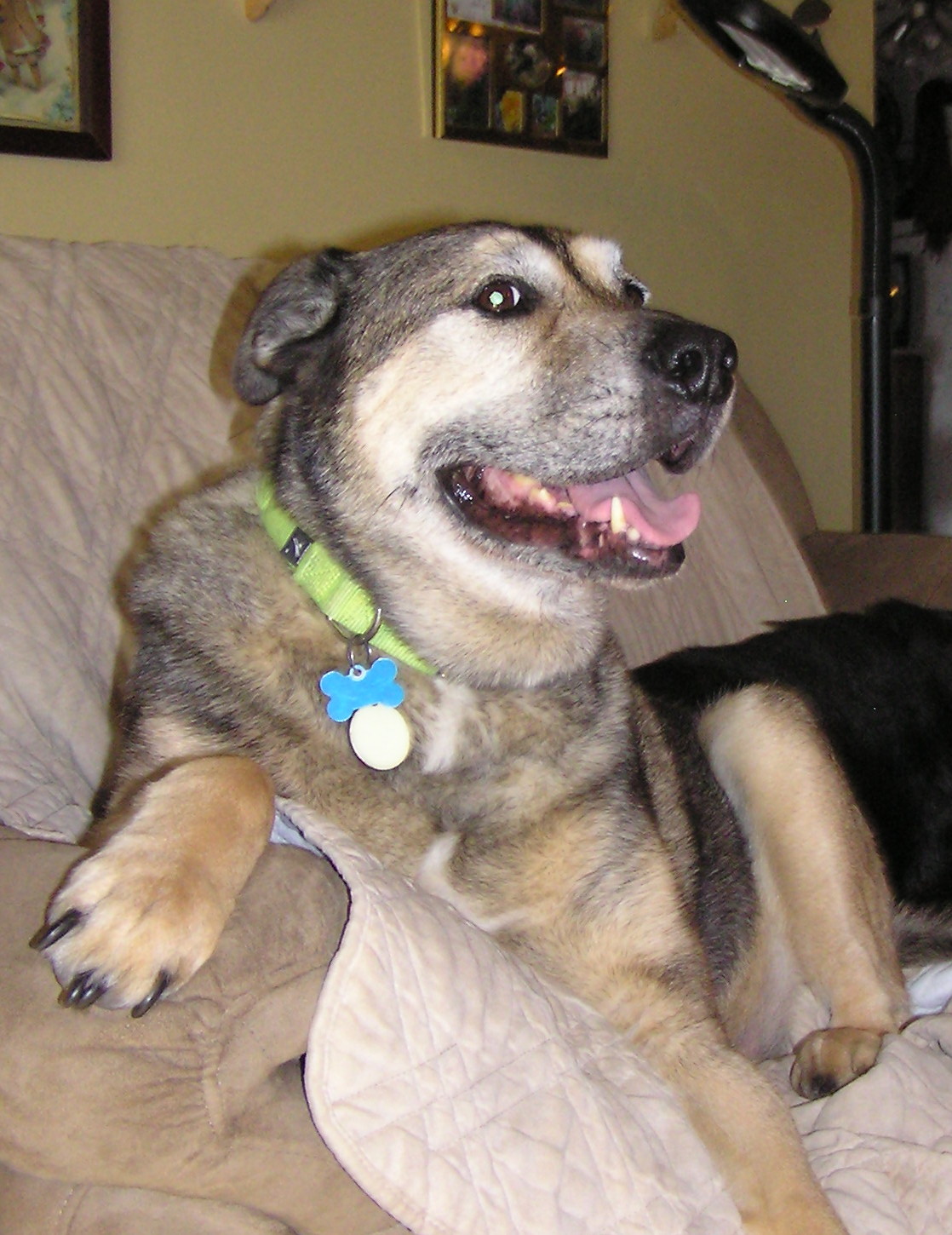
Duke, one of the Krutsinger’s Old Dog Haven dogs, enjoys life on the couch.
“Stylish slipcovers can come in handy if you have nice furniture as they are easily washable. Plus, when company comes, you can pull them off, hide the covers and there is your nice furniture!” Sandy explained.
Applying it at home
So, inspired by my friends’ ingenuity, I started the quest for style and livability in my pet-filled home. Laminate flooring has come a long way, and my husband and I found that a simulated-wood floor could take what our pets could dish. It mops like linoleum but looks like hardwood, without any dents caused in wood floors from Toby running in and out of the house at top speed.
Plus, Buca’s accidents outside the litter box are of no concern to me now. Today’s laminate floors are made for pets.
In recent years we have been through two semi-durable rugs for the living room. The first one, a small, long-pile rug, was eaten by Toby when he was a puppy. I don’t mean metaphorically: Toby actually pulled out the pile and ate it.
Short-pile rugs seemed like a good idea until Toby’s tail-chasing began. It turns out that low-pile that is not well secured gets scratched out by dog claws.
Then my sister suggested a sturdier alternative: carpet tiles. Our research led us to a company that makes carpet tiles of all piles, colors, textures and patterns. We bought rubber-backed carpet tiles with sewn-in, quarter-inch pile.

Duchess on ‘carpet tiles’
Six months into our trial, the tiles had been tested with cat claws, dog claws and liberal amounts of fur. Amazingly, there is no sign of damage, and the tiles release fur easily with vacuuming.
Wipe-able wall paint by our back door solved Toby’s mud-painting aspirations, and a hand-held, wet-dry vacuum is a good investment for hairball spots on the carpet.
Washable rugs are always a simple fix for hardwood floors that collect fur, and the application of clear, double-sided tape to walls or trim surfaces discourages their use as a scratching post.
Of course, there are many more solutions to living with pets, and I have more to implement. In the meantime, I’ll encourage the Krutsingers and their eight dogs to write us a book on practical dog cohabitation.
For more information on Old Dog Haven, visit its website at www.olddoghaven.org.
CHRISTIE LAGALLY is a freelance pet columnist who writes a blog called “Sniffing Out Home: A Search for Animal Welfare Solutions” at http://www.sniffingouthome.org.
 Christie Lagally